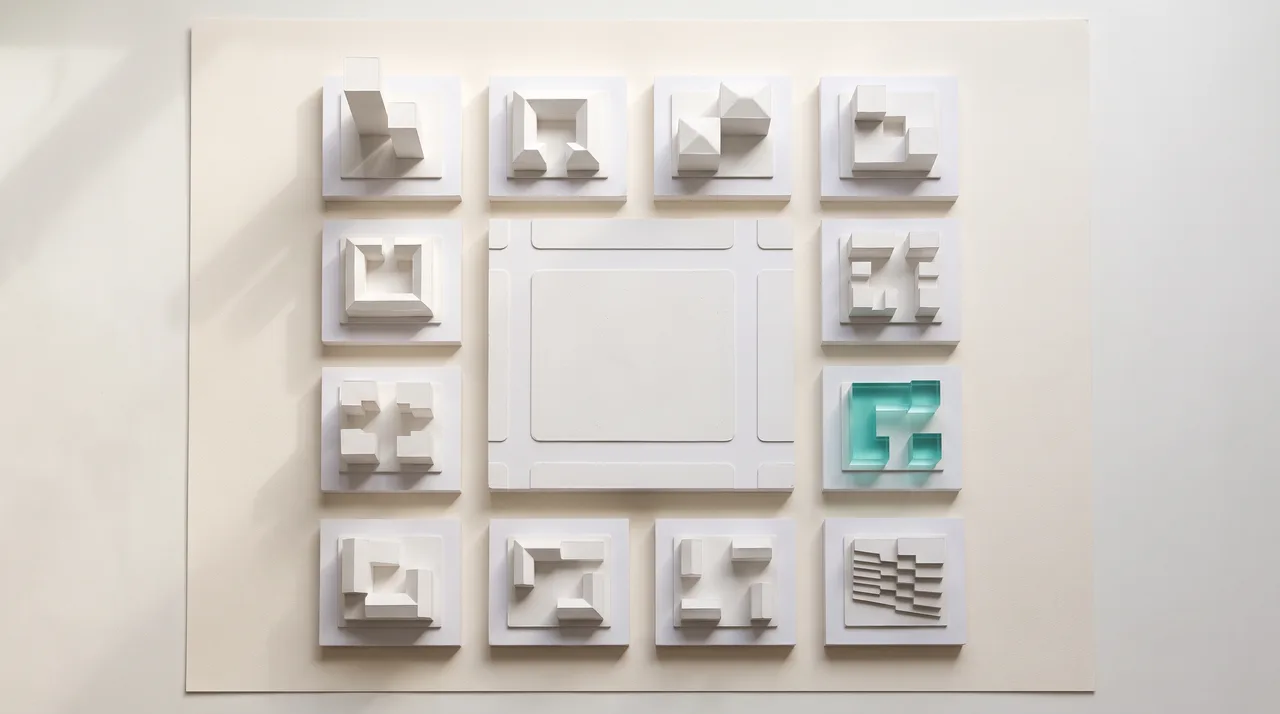

What a Decision Record Should Contain
The decision, its owner and authority, the alternatives, the evidence and the conditions: what lets a board revisit a choice years later.
Large developments are built over many years, often longer than the tenure of the people who decided what to build. Boards change. Consultants are replaced. Policy moves. At some point someone will ask why the project took the shape it did, and whether that reason still holds.
Most organizations cannot answer that question well. They have minutes recording that a paper was approved, a final report and a set of renders. What they rarely have is the reasoning: which options were compared, on what evidence, what was traded away, and under what conditions the choice was expected to hold.
A decision record exists to keep that reasoning. It is short, it is written at the moment of decision, and it is structured so that someone who was not in the room can understand it and challenge it.
01What Survives, and What Is Lost
What survives a decision is usually its output: the chosen masterplan, the approved budget, the signed agreement. What is lost is its context.
- The alternatives disappear, because only the winner is carried forward.
- The assumptions are buried in models that later versions overwrite.
- The trade-offs are remembered by a few people, each a little differently.
- The conditions attached at the time are forgotten when circumstances change.
Without that context, a later team can only accept the decision as given or reopen it from scratch. Neither is a good use of anyone's time.
02The Seven Fields
A useful decision record answers seven questions. Each can usually be answered in a sentence or two.
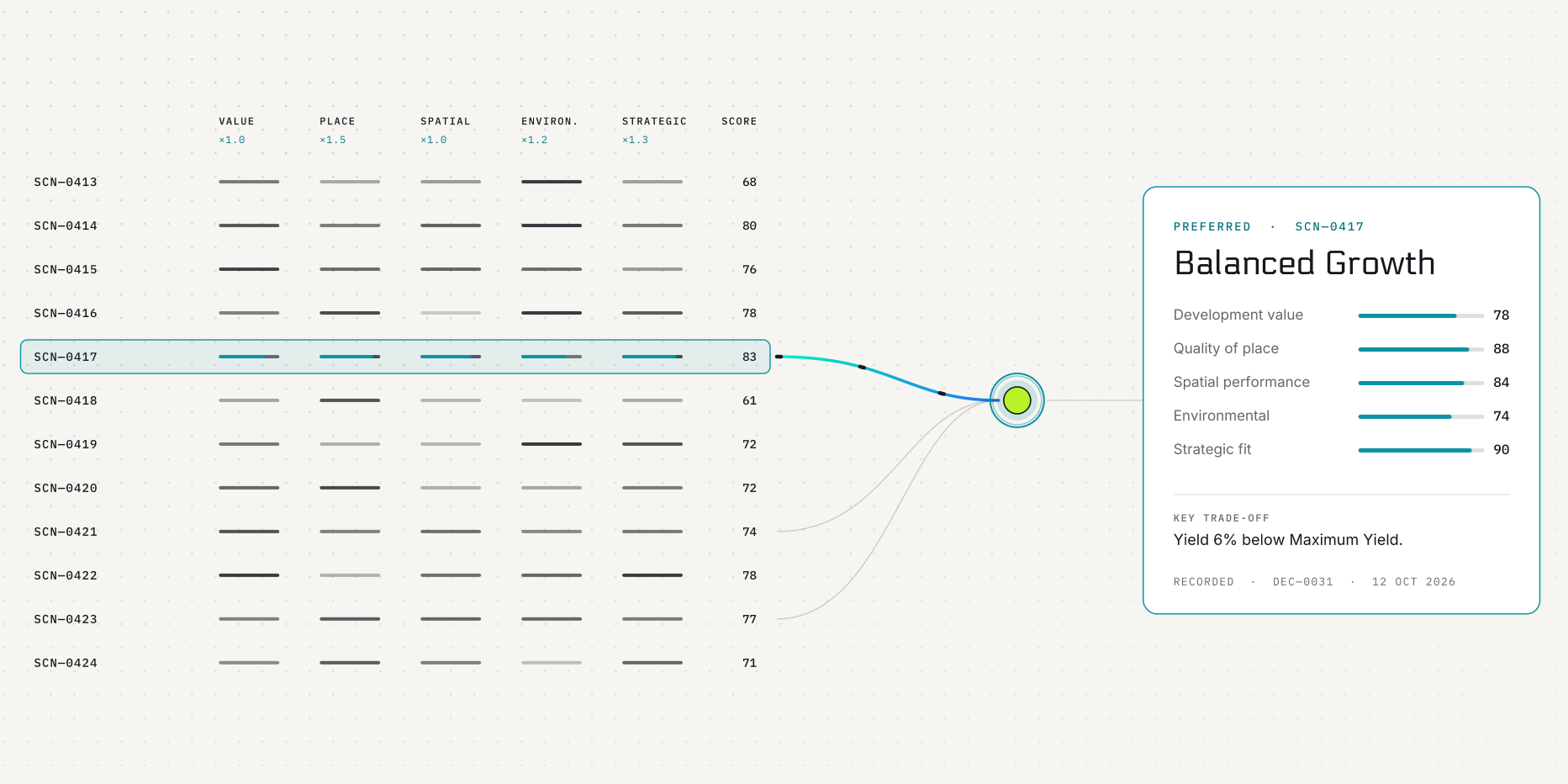
- The decision. State it as a choice, not a topic. "Proceed with Balanced Growth (SCN—0417) for Phase 1" is a decision. "Masterplan update" is not.
- Owner and authority. Who made the decision, and under what delegation. A committee recommendation and a board approval are different things.
- Alternatives considered. Name each option that was seriously compared, and say briefly why it was set aside.
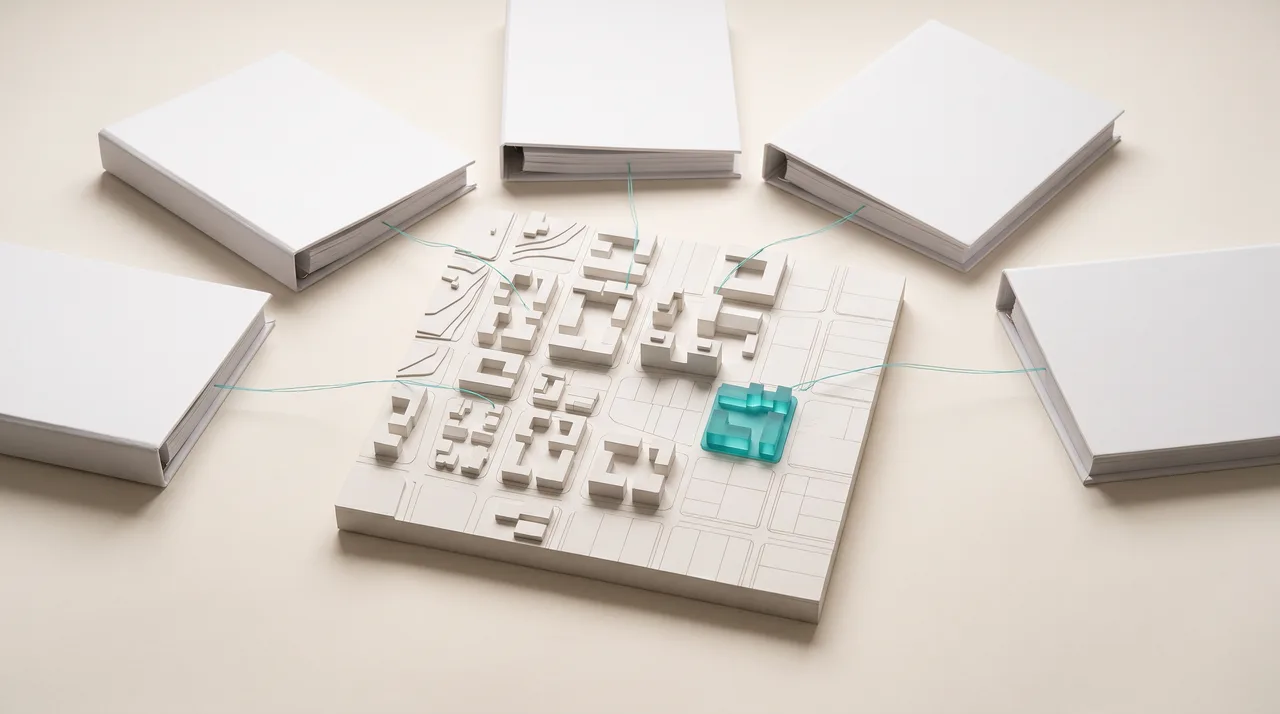
- Evidence. The sources and their versions, and the criteria and weights used to compare the options. Mark what was observed, what was modelled and what was not assessed.
- Rationale and trade-offs. Why this option, in plain language, and what was given up to choose it.
- Conditions. What must remain true for the decision to stand, and what would trigger a review.
- Date and status. When it was recorded, and whether it is a draft, reviewed, approved or superseded.
Proceed with Balanced Growth (SCN—0417) for Phase 1
- Owner · authority
- Development Committee · delegated by the board
- Alternatives
- Maximum Yield (SCN—0421): highest value, weakest place quality. Quality of Place (SCN—0423): lowest value and strategic fit.
- Evidence
- 12 scenarios on 5 weighted criteria · site model v4 · cost plan v12 · market study v2 · environmental: not assessed
- Rationale
- Strongest place quality and strategic fit; yield 6% below Maximum Yield.
- Conditions
- Phase 1 open space delivered before the first residential release. Review if the environmental assessment changes the park.
- Recorded · status
- 12 Oct 2026 · Approved
03What a Decision Record Is Not
A decision record is not the minutes of the meeting. Minutes record what was said. The record captures what was decided, and why.
It is not the final report either. Reports are long, written for a particular audience and usually finished before the decision is taken. The record is written at the decision gate and points to the reports rather than repeating them.
Above all, it is not a justification written after the fact. A rationale reconstructed months later tends to explain the outcome rather than the reasoning. Writing the record at the moment of decision is what makes it trustworthy.
04Superseding Without Erasing
Decisions change, and they should when the evidence does. The mistake is to overwrite the old decision as if it had never been made.
When a decision is revisited, a new record supersedes the previous one and links back to it. The earlier record keeps its reasoning intact and its status changes to superseded. Over the life of a project this builds a lineage: a sequence of decisions, each with its evidence and conditions, that shows not only where the project is but how it got there.
05Starting With the Next Gate
A decision record does not need new software or a new governance framework. It needs a template and the habit of using it.
- Keep it to one page. If it needs more, the decision has not been framed tightly enough.
- Attach it to the decision gate, so that the record is a condition of approval rather than an afterthought.
- Link to the evidence instead of restating it, and record the version of each source.
- Give every scenario and every decision an identifier, so that later records can refer to them precisely.
In Hakken, the decision record is where the work ends: the chosen direction, the alternatives, the evidence and the owner, kept together as a single source of decision truth. The principle holds with or without a platform. A decision that cannot be explained later was not fully made at the time.