
Why Masterplans Need a Single Source of Decision Truth
When every consultant holds a different version of the plan, the decision is made by whichever report arrives last.
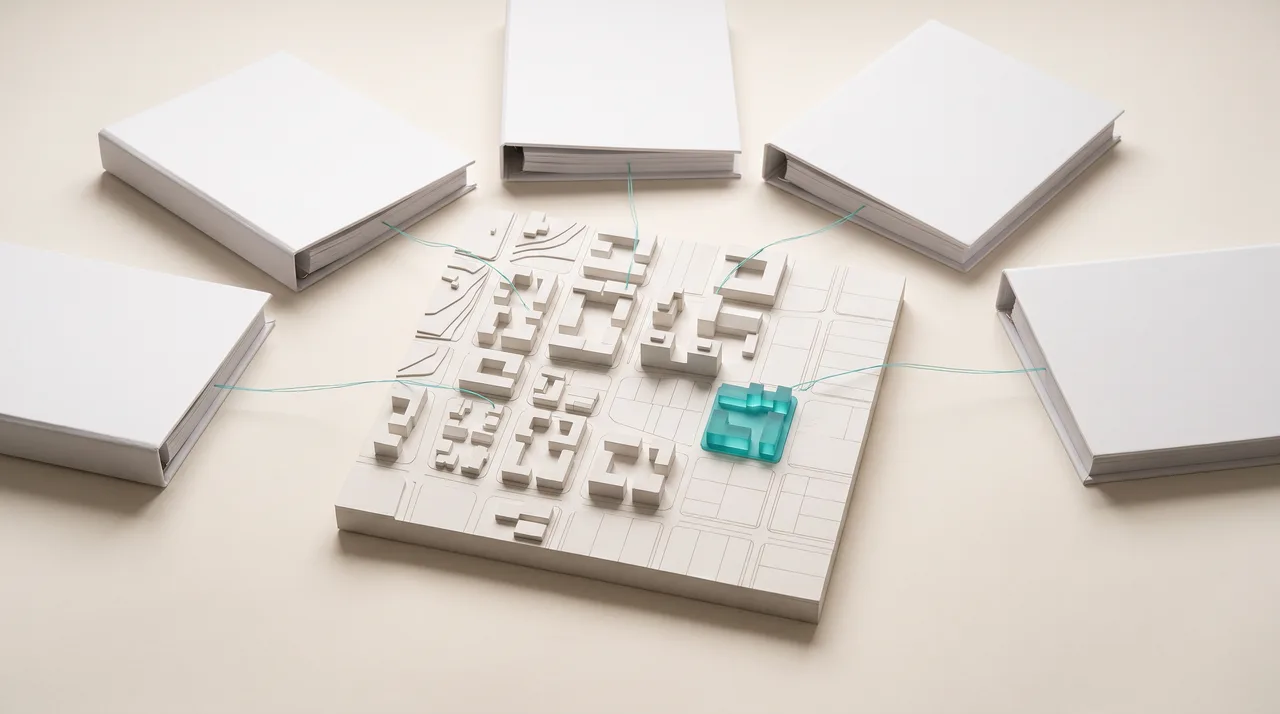
A large masterplan is advised by many disciplines. A spatial consultant maintains the GIS. A cost adviser runs feasibility. An architect develops the plan. A transport engineer models mobility. An advisory firm studies the market. Each works in its own tools, on its own timeline, and each produces good work.
Each also holds its own version of the plan. The GIS is on version four. Feasibility is on version twelve, marked final. The masterplan is on a revision of version six. Every one of them is correct on its own terms, and none of them quite matches the others.
01Six Versions of One Site
Version drift is not carelessness. It is what happens when disciplines work in parallel on a moving target. The masterplan changes, and the feasibility model catches up two weeks later. The mobility model is rerun on a layout that has since been revised. The market study assumes a unit mix the architect has already changed.
The result is that no single document describes the scheme as it stands, and no two documents describe it the same way. Options are compared across studies that were never aligned, on assumptions that were never reconciled.
02Decisions Made by Sequence
When the evidence is fragmented, decisions are not made by evaluation. They are made by sequence.
Whichever report lands before the steering meeting frames the discussion. Capital commitments follow the program calendar, not the arrival of the evidence. The market study that would have changed the unit mix arrives a month after the land price was agreed. The environmental assessment that would have moved the park arrives after the plot layout was fixed.
- GISSpatial consultantv3v4
- FeasibilityCost adviserv7v9v12_final
- MasterplanArchitectv5v6_rev
- 3D modelVisualizerv2
- MobilityTransport engineerv3v3b
- MarketAdvisory firmv1v2_draft
Six workstreams · six timelines · no shared evidence base
Nobody chose this order. It is what happens by default when there is no shared place where the decision itself is assembled.
03What a Single Source of Decision Truth Is
A single source of decision truth is not a single tool. Consultants should keep the software they are expert in, and no platform should try to replace a transport model or a cost plan.
Nor is it one giant model of everything. Detail belongs in the specialist tools. What needs to be held in common is narrower: the information required to compare the options and make the decision.
It is the one place where the inputs to a decision are reconciled, versioned and compared, and where the decision itself is recorded.
04Four Things to Hold in Common
In practice, four things need to be shared across every discipline working on a masterplan:
- The site and its constraints. One spatial model of the land, its controls and its context, against which every option is tested.
- The assumptions. Densities, costs, prices, absorption and phasing, each with an owner and a version.
- The scenarios. Every option under consideration, named for its priority and given an identifier, so that every study refers to the same thing.
- The criteria and weights. The basis on which options are compared, agreed before the results are seen.
On top of these sits the decision record: the chosen direction, the alternatives, the evidence and the owner.
05What Changes for Each Party
For a government authority or master developer, it means comparing competing directions on comparable evidence, and being able to defend the choice to the board, the authority and the teams that deliver it.
For consultants, it means their analysis counts at the moment of decision rather than arriving as a report after it. Hakken extends their work. It does not replace it.
For investors and committees, it means any figure in a recommendation can be traced to its assumptions, sources and versions, and challenged before capital is committed.
06Starting With One Decision
Moving a whole program onto a shared basis at once is rarely practical. Starting with the next significant decision is.
Pick the next gate that commits land, capital or design resources. Agree the options, the criteria and the shared assumptions before the studies are commissioned. Bring the outputs together on one basis, compare them, and record the outcome. Then do the same for the decision after that.
The aim is not to centralize the work. It is to make sure that when the decision is taken, everyone is looking at the same plan.